Ragdoll
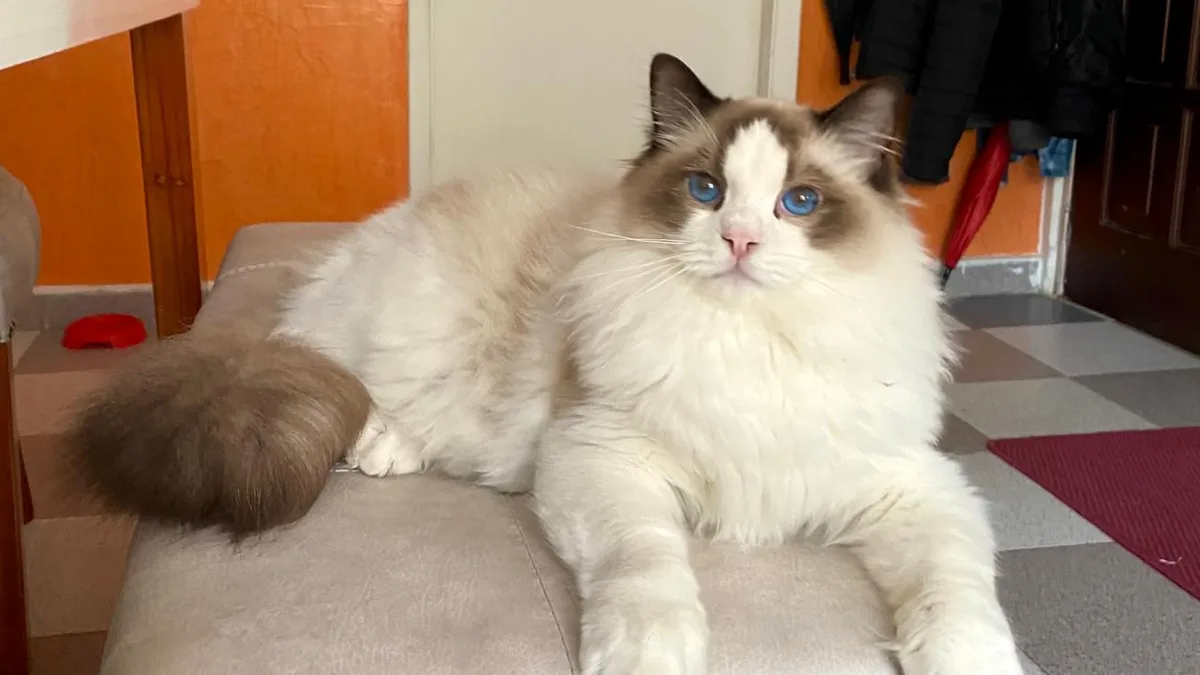
Large, semi-longhaired feline famous for striking blue oval eyes, docile temperament, and affectionate disposition.
Ragdoll Fast Clinical Specifications
Adult Weight
Maturation Time
Litter Box Size
Average Lifespan
Daily Calories
Coat Care
Ragdoll Temperament & Behavioral Profile
Ragdolls are renowned for their uniquely tranquil, gentle, and dog-like temperament. They are relaxed indoor felines that actively seek human affection, often flopping onto their backs or relaxing their limbs completely when cradled.
Affection & Lap Tendency
Unusually affectionate; prefers staying in close contact with owners throughout the day.
Good with Children
Patient and forgiving; does not extend claws readily during gentle play.
Harmony with Dogs & Other Cats
Very peaceful; rarely aggressive or territorial with other indoor pets.
Vocalization & Meow Volume
Extremely soft, musical chirps and purrs; rarely loud or demanding.
Playfulness & Energy Level
Moderate play bursts; loves wand toys and soft fetch, followed by long naps.
Tolerance for Being Handled
Loves being held; famously relaxes its muscle tone when scooped into arms.
Family & Home Compatibility
Superb for households with children, gentle dogs, and work-from-home pet parents. Because of their non-defensive nature, Ragdolls should strictly be kept as 100% indoor cats. Bringing home a kitten? Browse our curated Cat Name Generator for fitting names.
Training & Daily Management
Ragdolls learn house routines quickly. They can easily be taught to play gentle fetch or walk on a harness using positive clicker training and freeze-dried salmon treats. Calibrate life-stage discipline and cognitive aging using the AAFP Cat Age Calculator.
Ragdoll Colors, Patterns & Coat Types
All Ragdoll kittens are born pristine white due to a temperature-sensitive albinism gene. Their true point colors and patterns gradually develop over their first 2 to 3 years. Coat texture: Plush, silky semi-longhair coat with minimal undercoat, resulting in low matting and a cloud-like rabbit-fur texture.
Seal Point Ragdoll
Rich dark seal-brown points (face, ears, tail, legs) set against an ivory-to-warm beige body.
Blue Point Ragdoll
Cool slate-gray points contrasting softly with a cool platinum-white body.
Chocolate Point Ragdoll
Warm milk-chocolate points against an ivory body, retaining cocoa tones throughout adulthood.
Lilac Point Ragdoll
Delicate frosty silvery-gray points with subtle lavender-pink undertones and bright white body.
Bicolor Pattern (Any Color)
Characteristic symmetrical inverted white 'V' on the facial mask, pink nose leather, white chest, belly, and all four white legs.
Mitted Pattern (Any Color)
Pure white front mittens, white hind boots up to the hock, white chin stripe running along the underside.
Lynx Point (Tabby Agouti)
Fascinating tabby striping etched into the mask, ears, and tail points, paired with distinct 'W' or 'M' forehead markings.
Flame (Red) & Cream Point
Vibrant apricot to warm coral points against clear white body; less common than traditional seal and blue.
Clinical Genetics & Coat Health Notice
Point coloration requires strict sapphire-blue eye standard in CFA/TICA. Always confirm the breeder conducts echocardiograms for familial feline HCM.
Ragdoll Kitten Development Timeline
Ragdoll kittens have a prolonged skeletal growth curve that takes 3 to 4 years to complete, requiring specialized high-protein, high-moisture kitten nutrition through month 12.
8 to 12 Weeks (Weaning & Point Development)
Faint point color begins emerging on ear tips and nose leather. Initial FVRCP feline core vaccine series begins.
4 to 6 Months (Rapid Bone Elongation)
Baby teeth shed for permanent fangs. Transition to an extra-large, low-rim litter box to accommodate their long spine.
7 to 12 Months (Kitten to Young Adult)
Spay or neuter window. Coat starts developing full adult density and neck ruff.
2 to 4 Years (Full Skeletal & Coat Maturity)
Final adult point pigment and deep chest ruff lock in. Establish annual veterinary blood panels and dental evaluations.
Large Frame vs Obesity in Ragdolls
Ragdolls are naturally large-boned, long-bodied cats with a legitimate fatty pad on their lower abdomen (a breed characteristic). However, an adult Ragdoll should never be allowed to develop excessive spine or rib fat rolls. Regular weight monitoring prevents joint stress and feline diabetes.
Interactive Veterinary Calculators for Ragdolls
Run customized formulas calibrated specifically for Ragdoll biological benchmarks, weight curves, and life stages.
Ragdoll Human Age Converter
Convert your Ragdoll's chronological age into human developmental stages according to AAFP standards.
Wet & Dry Calorie Ratio Splitter
Calculate optimal moisture and protein ratios between premium canned food and dental kibble.
Feline Lifespan & Senior Health Checklist
Track organ development milestones and age-based veterinary lab screening recommendations.
Ragdoll Queen Gestation Tracker
Track feline pregnancy day-by-day with palpation windows, ultrasound confirmation, and nesting cues.
Hereditary Health & Clinical Watchlist
Hypertrophic Cardiomyopathy (HCM)
Genetic thickening of the left ventricular myocardium, impairing heart blood pump capacity.
Ensure breeder provides DNA screening for the MYBPC3 gene mutation. Schedule echocardiograms if murmurs appear.
Polycystic Kidney Disease (PKD)
Inherited condition causing progressive fluid-filled cysts in renal tissue.
Ultrasound screening can confirm normal renal structure from 10 months of age onward.
Trichobezoars (Hairball Impaction)
Semi-long coats ingested during self-grooming can clump into gastrointestinal blockages.
Brush twice weekly with a stainless steel comb and maintain a high-moisture wet food diet for intestinal motility.
Portion Control & Nutrition Notes
Because Ragdolls have a large muscular frame that grows continuously for up to 4 years, avoid abrupt puppy/kitten diet transitions. High moisture intake through wet canned food is essential to protect against feline lower urinary tract disease (FLUTD). To balance canned moisture against dry food calories, launch the WSAVA Wet & Dry Calorie Splitter.
Fascinating & Verified Ragdoll Facts
Surprising anatomical, historical, and behavioral traits confirmed by veterinary researchers and breed historians.
All Kittens Are Born 100% Pure White
Because the Siamese-patterned albinism gene is temperature-sensitive, all Ragdoll kittens develop in the warm womb without color and are born snow-white. Their points only start emerging in cooler areas (ears, tail, paws) after birth.
The Famous 'Limp Doll' Muscle Reflex
The breed was named 'Ragdoll' because many individuals completely surrender their muscle tone and flop peacefully into the arms of humans they trust, resembling a child's plush toy.
Known as the 'Puppy Cat'
Ragdolls exhibit classic canine behaviors: they greet owners at the front door, follow family from room to room, and often fetch tossed toys with enthusiasm.
One of the Slowest-Maturing Domestic Cats
While most cats complete physical growth around their 1st birthday, Ragdolls continue developing skeletal width, muscle density, and adult coat color until 3 to 4 years of age.
Ragdoll Origin & Historical Evolution
The Ragdoll breed was established in the 1960s in Riverside, California, by breeder Ann Baker. Starting with a white domestic longhaired matriarch named Josephine, Baker selectively cultivated cats that demonstrated extraordinarily peaceful, gentle temperaments and a distinctive tendency to go completely limp when held.
The Matriarch Josephine & Ann Baker
Ann Baker mated Josephine (a longhaired white Persian-type queen) with feral pointed males, observing kittens with exceptionally loving dispositions and blue eyes.
Creation of the IRCA
Baker trademarked the 'Ragdoll' name and formed the International Ragdoll Cat Association (IRCA) with strict franchise breeding controls.
The Dayton Family & Major Registry Recognition
Denny and Laura Dayton split from Baker to legitimize Ragdolls under major scientific feline registries, gaining official Championship status in TICA and CFA.
World's Most Popular Pedigreed Feline
Ranked consistently as the #1 most registered cat breed globally by the Cat Fanciers' Association (CFA) for multiple consecutive years.